 CSOradio
 CSOtv
CSOtv
 CSOradio
Earl Lee, here leading the Ann Arbor Symphony Orchestra, makes his CSO podium debut Aug. 16 at Ravinia.
In 2008, just before emerging cellist Earl Lee was set to return to the Steans Institute at Ravinia, he received a diagnosis that would force him onto a new musical path.
This summer, Lee will perform Aug. 16 at Ravinia for the first time in 19 years, now as a mid-career conductor, in his Chicago Symphony Orchestra debut. He will lead the CSO in the festival’s nearly 50-year tradition: the Tchaikovsky Spectacular. The concert marks a milestone in a long journey that began when a neurological disorder derailed Lee’s promising future with the cello.
He had spent a pleasant and instructive summer at Steans in 2007, studying chamber music with about 30 other string musicians and pianists, receiving expert coaching from the faculty — which that year included Leon Fleisher, Claude Frank and Menahem Pressler — and performing in several concerts.
But in early 2008, he began to suffer from focal dystonia, a rare condition that causes involuntary movements of the hands or fingers. In his case, the spasms in his left middle finger meant that he could no longer control the cello strings. “Three weeks before the summer started, I remember calling Miriam Fried,” he said, referring to the longtime director of the Steans Piano & Strings Program, “and telling her that I can’t play a simple scale, I have to drop out.”
For three years, he tried to retrain and recover, but nothing worked. Finally, he realized, “I love music and I have to be a performer.” He decided to pursue conducting, which had been a side interest up until then.
Lee still retains fond memories of his Steans summer. “I was continuing to craft my skills as a cellist, but also making music at a high level,” he said. “The friends I made there I’ve kept in touch with, and they’re all doing wonderful things in their careers.” (The 2007 Steans alumni include the Ariel Quartet, Boston Symphony principal cellist Blaise Déjardin and Grammy-nominated violinist Tessa Lark.) Walking across the Lawn to hear the CSO was also a highlight for Lee.
And his past life as a cellist helps him as a conductor. He gets his cello out sometimes as he is preparing to conduct a new piece. Many conductors, though not all, began their career as instrumentalists, and Lee’s experience as a chamber musician and in student orchestras informs his work on the podium. “Sometimes I take my cello out to have an imaginary Earl Lee in front of me as a conductor,” he said, “and me in the cello section to see if that would make sense.”
After his conducting studies at the Manhattan School of Music, Lee did stints as a staff assistant conductor at the Toronto, Pittsburgh and Boston symphonies. The Toronto job, his first, was something of a homecoming for him; he was born in Korea, but moved to Canada as a child; his first cello teacher was a member of the Toronto Symphony. “It was like salmon returning to its birthplace,” he said. “All the musicians at that time, they saw me as their kid and were very embracing.”
Each job along the way taught Lee about different aspects of the profession. “A conducting career is really hard, and I’ve been lucky,” he said. Winner of the 2022 Sir Georg Solti Conducting Award, Lee is currently music director of Michigan’s Ann Arbor Symphony Orchestra and also maintains a full schedule as a guest conductor.
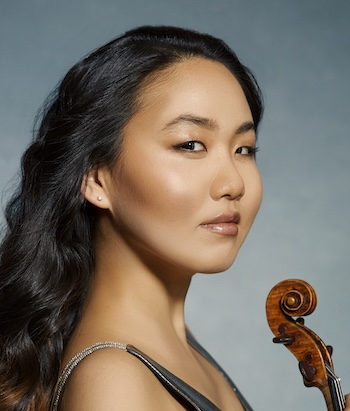 Lee’s debut with the Chicago Symphony will present its own challenges as he leads the traditional all-Tchaikovsky concert, often the grand finale of the CSO’s annual residency, as it is this summer.
Ending with the 1812 Overture is a requirement — its performance with Ravinia’s firing replica military cannons is a now 45-time part of the tradition — and violinist Stella Chen (at left) was already engaged to play the program’s showpiece concerto, which gave him about half an hour to fill with his choice of repertoire.
Lee thought about programming one of the Russian master’s symphonies, but he decided that there wouldn’t be enough rehearsal time for such a major work. Instead, he and the CSO’s leaders agreed on the Polonaise from Tchaikovsky’s opera Eugene Onegin and the composer’s Romeo and Juliet-inspired fantasy-overture. “The 1812 is quite substantial, and Romeo and Juliet is not a small piece by any means,” he said. “I think it’s a fun concert, and we can do a lot with it.”
Conducting any orchestra for the first time is like a blind date, Lee said. Both parties may know a little about each other by reputation — among his past engagements and honors — but in person, “an orchestra has its own unique collective personality. That chemistry between people is discovered in the first 20 or 25 minutes of rehearsal.” At first, he said, he will conduct minimally and then begin to express a little more. “It’s a little bit nerve-wracking,” he said, “because you don’t know which way it’s going to go.”
With his soloist, however, Lee will be on familiar ground. He met Chen in 2022 when they made their New York Philharmonic debuts on the orchestra’s Lunar New Year Concert and Gala, and they have kept in touch since. “I love working with Stella,” he said. “She’s such a virtuoso, but she does a lot of chamber music, and that’s my background. It always feels very organic. You can breathe together. There’s always room to dance around.”
Traditionally, the soloist and conductor get together before the first orchestral rehearsal to talk about the piece or play through it, but Lee and Chen were texting already in May. “She asked what I thought about cuts in the last movement, and I said we would do whatever she wanted,” he said. “A conductor’s job is to be a supporter and make the soloist’s concept of the piece come alive.”
Tchaikovsky’s Violin Concerto is famous as a technical tour de force, but Chen is also concentrating on “the challenge of spinning all of its pyrotechnics and technical madness into balletic beauty and delight.” She recently had the chance to dance with Mikhail Baryshnikov, and “it will forever be one of the greatest moments of my life,” she said. "I am one of the clumsiest people alive, but thankfully that is no barrier to my musical imagination. With this piece, I adore letting that imagination run wild.”
Like Lee, Chen is also a Steans alum. She remembers her summers there in 2013 and 2014 as “[both] grueling and inspiring, spending every day thinking about discussing, rehearsing and performing music from 7 a.m. until 11 p.m., for five straight weeks.” Unlike Lee, she has come back multiple times in the intervening years as a soloist and chamber musician. “It feels very much like a summer home away from home,” she said. “Returning in this way is incredibly meaningful.”
This is an excerpt from an article published in the Ravinia magazine. To read the full version, click here. Reprinted with permission.


