 CSOradio
 CSOtv
CSOtv
 CSOradio
Circa 1955, a young girl sits on top of her bed, reading a Mother Goose storybook.
Photo by Harold M. Lambert/Lambert/Getty Images
Mother Goose is a character from children’s literature, ascribed a treasure trove of nursery rhymes, songs and stories. The Chicago Symphony Orchestra, in a co-production with singer-songwriter Natalie Merchant, Chicago Children’s Theatre and the Negaunee Music Institute, presents its own musical adaptation of her tales in Mother Goose & the Cabinet of Wonder, performed May 8 and 9 and available on a content-rich website designed for young children, their teachers and caregivers — cabinetofwonder.org. As described in an introductory video for the project, “Miss Natalie has reimagined Mother Goose for a new generation.” But who or what is the original source and how have these rhymes endured?
Detail of the opening verse of "Old Mother Goose and the Golden Egg", a poem based on the plot of the popular pantomime first performed in 1806, "Harlequin and Mother Goose, or The Golden Egg".
Book published 1860, collection of McGill University
The identity of the original Mother Goose remains a mystery. The name starts to appear regularly in English and French collections of children’s stories during the 17th century, with the first confirmed written reference to Mother Goose appearing in Jean Loret’s published letters of 1650.
There is one theory that “the real” Mother Goose might have been Bertha of Burgundy, the wife of King Robert II of France (ca. 972-1031), often called Berthe pied d’oie (Goose-Footed Bertha) or Berthe la fileuse (Bertha the Spinner) for spinning tales that enchanted children. King Charlemagne’s mother, Betrada of Laon, was known as Regina pede aucae, or “the queen with the goosefoot,” in addition to her other nickname that translates to “Berthe Broadfoot.” Tales of Berthas with some kind of animal or magical foot, that originate from the Dark and Middle Ages, exist in many languages. In the early 19th century, Jacob Grimm, of the Brothers Grimm, linked the stories to the Alpine folklore character Perchta, who was also associated with spinning and having one large goose or swan foot.
The evolution of Mother Goose was also informed by the characters of Mother Hubbard, who had been a common figure in children’s stories in England since 1690, and the prolific Countess d’Aulnoy, who published Les Contes des Fées (Fairy Tales) in 1697 and was known in England by the pseudonym “Madame Bunch.”
There was also a very popular pantomime, in which Mother Goose was a central character, first performed at Covent Garden on Boxing Day, December 26, 1806. Since it was difficult to create a costume that gave an actor a mobile goosefoot, the character was often portrayed as a woman with a pointy witch’s hat who rode a goose and/or had a goose companion. This became the standard depiction of Mother Goose in illustrations of her stories thereafter.

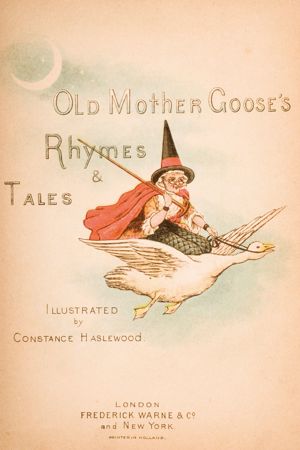
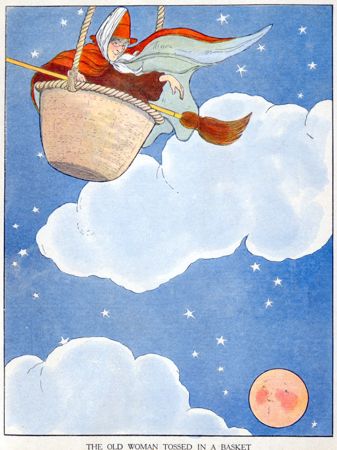
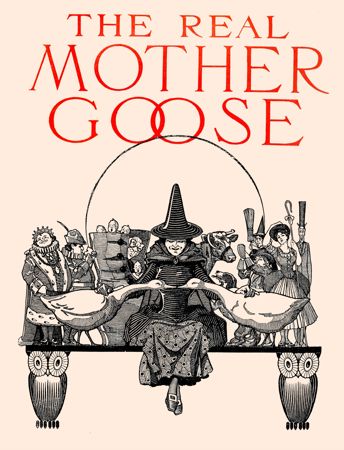
Charles Perrault (1628-1703) published a collection of fairy tales in 1695 titled Histoires ou contes du temps passés, avec des moralités. This collection became better known under its subtitle of Contes de ma mère l’Oye or Tales of My Mother Goose, and facing its title page is a depiction of an older woman with a distaff (a stick for spinning wool or flax) telling stories to three children by a fireside. According to Charles Francis Potter’s Standard Dictionary of Folklore, Mythology, and Legends, Perrault’s publication marks the first authenticated origin for Mother Goose stories. An English translation of Perrault’s collection, Robert Samber’s Histories or Tales of Past Times, Told by Mother Goose, appeared in 1729 and was reprinted in America in 1786.
For a time, Americans claimed that ’the real’ Mother Goose was the Bostonian wife of Isaac Goose, either named Elizabeth Foster Goose (1665–1758) or Mary Goose (d. 1690; her gravestone is in the Granary Burying Ground in Boston). According to this account, the couple had six children together, and Issac already had ten from a previous marriage. Once widowed, she went to live with her oldest daughter, who was married to the publisher Thomas Fleet. He released Songs of the Nursery, or Mother Goose Melodies for Children in 1719. According to Fleet’s great-grandson in reports from 1860, his great-great-grandmother, Mother Goose, would tell stories to her many grandchildren all day and was ’the’ source. His claims have been broadly dismissed by scholars, with no disrespect to Mrs. Isaac Goose.
The English publisher John Newbery (1713–1767), considered the “Father of the Children’s Literature” and namesake of the famous Newbery Medal, supposedly published a set of nursery rhymes titled Mother Goose’s Melody, or Sonnets for the Cradle sometime in the 1760s, although no copies remain. There are confirmed editions with the same title from the 1780s, published by his stepson Thomas Carnan. Back in the United States, Boston’s Munroe and Francis published Mother Goose’s Quarto in 1825, followed by Mother Goose’/s Melodies in 1833. By this time, the name Mother Goose and the term “Mother Goose rhyme” were both widely established in the English-speaking world.
Frontispiece of the first known English translation of Perrault’s "Contes de ma mère l'Oye" or "Tales of My Mother Goose," 1729
Houghton Library, Harvard University
Since there is no definitive edition or source of all the rhymes attributed to Mother Goose, seemingly endless editions of Mother Goose rhymes have been published, with many including the same famous verses, from “Humpty Dumpty” to “Peter Pumpkin Eater” and “Little Miss Muffet” to “Jack Sprat.” Despite their centuries-old sources, these nursery rhymes remain a relevant tool in teaching the principles of language. The rhymes are typically short, combining deliberate language features with entertaining stories. Their use of rhyming patterns, and often alliteration, enhance their memorability, as do their imaginative and playful stories. Mother Goose & the Cabinet of Wonder capitalizes on these qualities, giving the nursery rhymes renewed relevance for 21st-century children as they support their language and musical development.


