 CSOradio
 CSOtv
CSOtv
 CSOradio
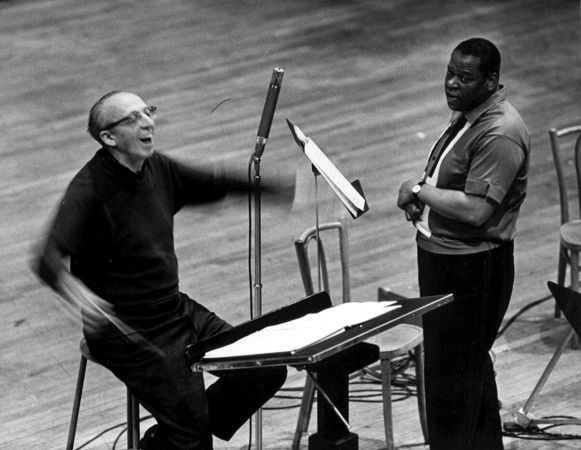
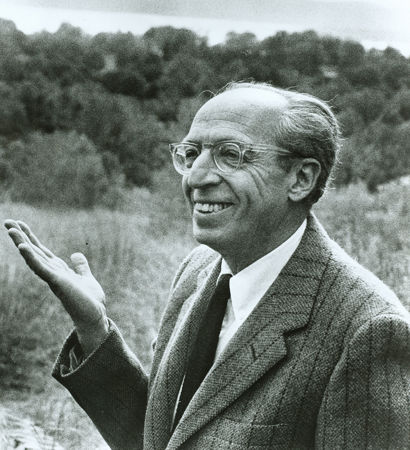
Aaron Copland in November 1960
Ben Martin via Getty Images
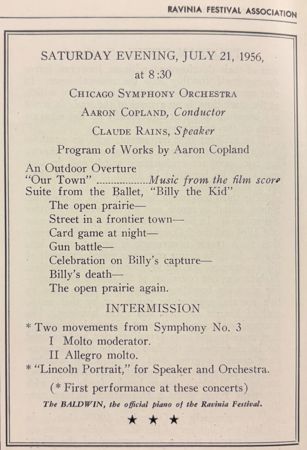
“The world’s gone topsy turvy and let no one tell you otherwise,” began Roger Dettmer in the July 22, 1956, Chicago American. “Hailstorms in the afternoon and 5,000 persons at Ravinia in the evening [for] an entire concert of Aaron Copland’s music conducted by Mr. Copland.” For the composer’s Chicago Symphony Orchestra podium debut, he had programmed his An Outdoor Overture, suites from Our Town and Billy the Kid, the first two movements from the Third Symphony and Lincoln Portrait with actor Claude Rains as narrator.
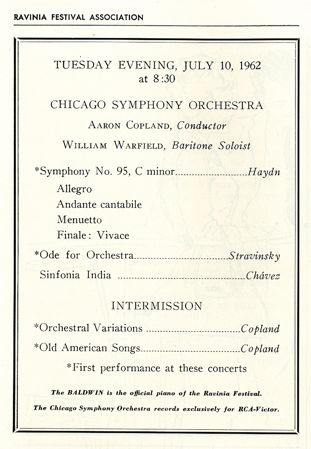
During his second residency at the Ravinia Festival, on July 10, 1962, Copland led the Orchestra in a program that began with Haydn’s Symphony no. 95, Stravinsky’s Ode for Orchestra and Chávez’s Sinfonia india. After intermission, the composer returned to lead his Orchestral Variations and Old American Songs. Copland’s appearance drew “the largest Tuesday crowd in many a Ravinia summer [and] everything added up to the best program given summer audiences here in a decade of concerts,” wrote Dettmer in the American. “The strongest music was Mr. Copland’s Variations, tense and unrelenting, splendorously scored, and in design, memorable.”
American bass-baritone William Warfield — who had given the premiere of the orchestral arrangement of the first set of songs as well as the first performance of the original version of the second set with the composer at the piano — was soloist for the occasion. Robert C. Marsh in the Chicago Sun-Times commented, “In the two sets of American songs, William Warfield showed us that the acoustically revamped pavilion is now a fit place for a vocal soloist, for his big, warm baritone came to us as no singer had before.”

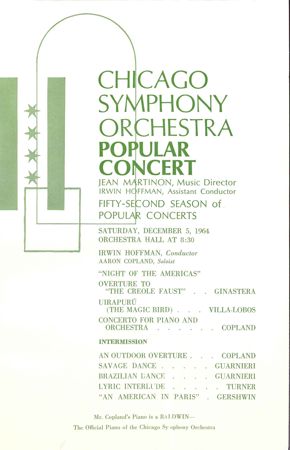
For his debut at Orchestra Hall, the composer was soloist in his Piano Concerto on December 5, 1964, led by assistant conductor Irwin Hoffman. In the Chicago Tribune, Thomas Willis observed that Copland “obviously enjoyed himself, pounding out syncopations, nodding to the reeds as they lipped ’blue’ notes, and elbowing assistance to offbeats, false accents and throwaway endings.”
He returned to the podium in early April 1970 — both in Orchestra Hall and in Milwaukee’s Uihlein Hall — to lead works by Berlioz, Carter and Tippett, along with his Symphonic Ode and a suite from Appalachian Spring. In the Sun-Times, Marsh speculated that the Orchestra might have been fatigued "from a heavy recording schedule with Georg Solti early in the week.* The result was a concert both pleasing and instructive [showing that] a good work of music does not need to be dramatized by a conductor and, in a clear and accurate statement, will have no difficulty speaking for itself.”
For Copland’s final appearance with the Chicago Symphony Orchestra, he was again a soloist, this time as narrator in his Lincoln Portrait for a July 4 concert during Ravinia’s 1982 season. The all-American program included his Fanfare for the Common Man and selections from Rodeo, along with works by Anderson, Cohan, Cowell, Herbert, Ives and Sousa. Erich Kunzel was on the podium.
*Between March 26 and April 8, 1970, in Medinah Temple, Georg Solti — in his inaugural season as eighth music director — led his first recording sessions with the Chicago Symphony Orchestra: Mahler’s Fifth and Sixth symphonies along with the Songs of a Wayfarer with mezzo-soprano Yvonne Minton.
Portions of this article previously appeared here. This article also appears here.


