 CSOradio
 CSOtv
CSOtv
 CSOradio
José van Dam in 1979
Santi Visalli (Getty Images)
The Chicago Symphony Orchestra family joins the classical music community in mourning the passing of legendary Belgian bass-baritone José van Dam, who died on February 17, 2026. He was 85.
Born on August 25, 1940, he studied at the Brussels Royal Conservatory and made his professional debut in 1960 as Don Basilio in Rossini’s The Barber of Seville at the Opéra Royal de Wallonie-Liège. Van Dam was soon engaged by the Paris Opera, and during his career, he performed in the world’s great opera houses, including the Royal Opera, Metropolitan Opera, Teatro alla Scala, Wiener Staatsoper, Deutsche Oper Berlin, Théâtre Royal de la Monnaie, Teatro Colón and the Salzburg Festival.
Van Dam amassed an extraordinary recording legacy, most notably in the operas Carmen, Louise, The Magic Flute, Don Carlos, Faust, The Tales of Hoffmann, Fidelio, Wozzeck, The Marriage of Figaro, Salome, Pelleas and Melisande and The Flying Dutchman, among many others. In 1983 he created the title role in the world premiere of Messiaen’s Saint François d’Assise at the Paris Opera. Van Dam also appeared in Joseph Losey’s film version of Don Giovanni as Leporello and in Gérard Corbiau’s The Music Teacher.
He was the recipient of numerous awards, including the Deutsche Oper Berlin’s Kammersänger and German Music Critics’ Prize. Van Dam also received the Gold Medal of the Belgian Press, the Grand Prix de l’Académie française du Disque, Orphée d’Or de l’Académie Lyrique Française, the European Critics’ Prize and Diapason d’Or and Prix de la Nouvelle Académie du Disque. He received three Grammy awards, the first for Best Classical Vocal Soloist Performance for an album of songs by Ravel with the BBC Symphony Orchestra and Ensemble InterContemporain under Pierre Boulez. Van Dam also received awards for Best Opera Recording for Strauss’ Die Frau ohne Schatten and Wagner’s Die Meistersinger von Nürnberg, both under the baton of Sir Georg Solti (the latter with the Chicago Symphony Orchestra and Chorus).
Van Dam appeared with the Chicago Symphony Orchestra and Chorus on several notable occasions — in Orchestra Hall, Carnegie Hall and on tour to London and Salzburg — as follows.
May 31, 1977, Orchestra Hall
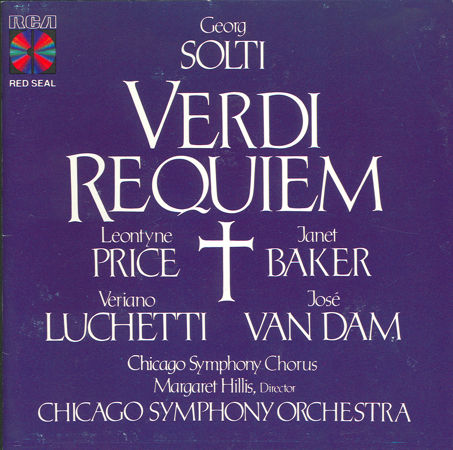
VERDI Requiem
Leontyne Price, soprano
Janet Baker, mezzo-soprano
Veriano Luchetti, tenor
José van Dam, bass-baritone
Chicago Symphony Chorus
Margaret Hillis, director
Sir Georg Solti, conductor
Verdi’s Requiem was recorded in Medinah Temple on June 1 and 2, 1977, for RCA. Thomas Z. Shepard produced the recording, and Paul Goodman was the engineer. The recording won the 1977 Grammy Award for Best Choral Performance (other than opera).
April 23 and 25, 1981, Orchestra Hall
May 1 and 2, 1981, Carnegie Hall
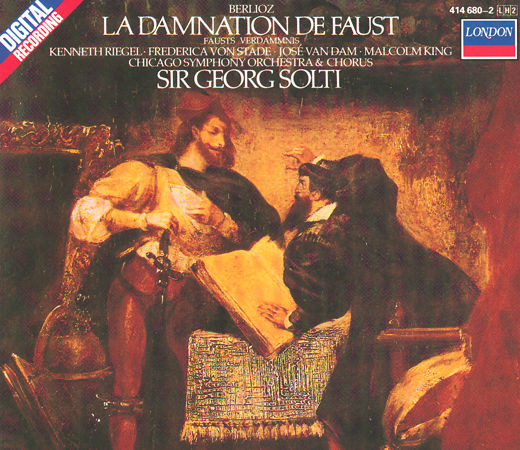
BERLIOZ The Damnation of Faust
Mary Beth Stephen, mezzo-soprano (April 23)
Claudine Carlson, mezzo-soprano (April 25)
Frederica von Stade, mezzo-soprano (May 1 and 2)
Kenneth Riegel, tenor (April 23 and May 1)
Peyo Garazzi, tenor (April 25 and May 2)
José van Dam, bass-baritone
Malcolm King, bass
Chicago Symphony Chorus
Margaret Hillis, director
Glen Ellyn Children’s Chorus
Doreen Rao, director
Sir Georg Solti, conductor
In the Chicago Tribune, John von Rhein wrote, “Riegel’s ardently sung, intensely drawn Faust fit securely into the Solti conception [and] he was never less than fascinating to listen to. Van Dam was even better, an urbane, impeccably stylish grand seigneur of a devil, his firm baritone rich in subtly sinister inflections. No better Mephistopheles could be imagined under contemporary vocal artists.”
Berlioz’s The Damnation of Faust was recorded by London Records in Medinah Temple on May 4, 5, 6 and 7, 1981. James Mallinson was the producer, and James Lock and Simon Eadon were sound engineers. The recording won the 1982 Grammy Award for Best Choral Performance (other than opera).
May 18, 19, and 20, 1989, Orchestra Hall
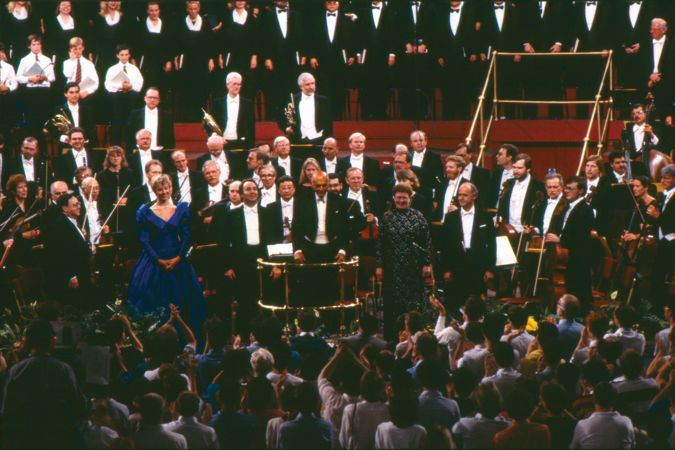
August 28, 1989, Royal Albert Hall, London, England
August 30, 1989, Grosses Festspielhaus, Salzburg, Austria
BERLIOZ The Damnation of Faust
Anne Sofie von Otter, mezzo-soprano
Keith Lewis, tenor
José van Dam, bass-baritone
Peter Rose, bass
Chicago Symphony Chorus
Margaret Hillis, director
Westminster Cathedral Choir (August 28 and 30)
James O’Donnell, director
Sir Georg Solti, conductor
The August 28 concert at the Royal Albert Hall was recorded for television broadcast and later released by London Records on video.

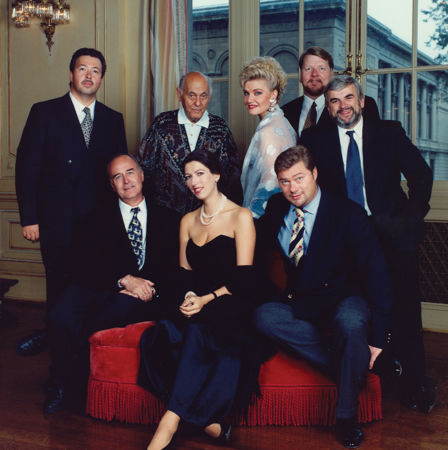
September 23 and 26, 1995, Orchestra Hall (acts 1 and 2)
September 24 and 27, 1995, Orchestra Hall (act 3)
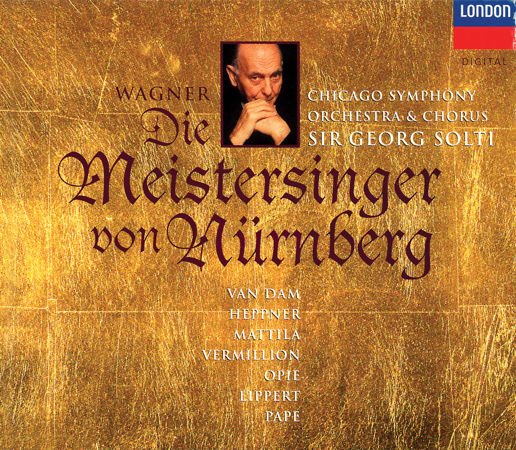
WAGNER Die Meistersinger von Nürnberg
Karita Mattila, soprano
Iris Vermillion, mezzo-soprano
Ben Heppner, tenor
Herbert Lippert, tenor
Alan Opie, baritone
José van Dam, bass-baritone
René Pape, bass
Roberto Saccá, tenor
John Horton Murray, tenor
Steven Tharp, tenor
Richard Byrne, baritone
Gary Martin, baritone
Kelly Anderson, bass-baritone
Kevin Deas, bass-baritone
Albert Dohmen, bass-baritone
Stephen Morscheck, bass-baritone
Chicago Symphony Chorus
Duain Wolfe, director
Sir Georg Solti, conductor
“Van Dam brought a lieder-singer’s sensibility to [the character of Hans] Sachs, his nobility of tone and keen interpretive intelligence making him an introspective, even melancholy poet-cobbler as well as a Mastersinger in the literal sense,” remarked John von Rhein in the Chicago Tribune.
For London Records, Wagner’s Die Meistersinger von Nürnberg was recorded live in concert and produced by Michael Woolcock; James Lock, John Pellowe and Neil Hutchinson were the balance engineers; and Krzysztof Jarosz was the location engineer. The recording won the 1997 Grammy Award for Best Opera Recording.
November 29, 30, and December 3, 1996, Orchestra Hall
RAVEL Don Quichotte à Dulcinée
RAVEL Five Popular Greek Melodies
MAHLER Three Rückert Songs (Ich atmet’ einen linden Duft, Ich bin der Welt abhanden gekommen, Liebst du um Schönheit)
Pierre Boulez, conductor
Van Dam also gave a recital in Orchestra Hall under the auspices of Symphony Center Presents.
November 2, 1997
BRAHMS Meine Liebe ist grün, Op. 63, No. 5
BRAHMS Dein blaues Auge, Op. 59, No. 8
BRAHMS Feldeinsamkeit, Op. 86, No. 2
BRAHMS Auf dem Kirchhofe, Op. 105, No. 4
BRAHMS Von ewiger Liebe, Op. 43, No. 1
STRAUSS Traum durch die Dämmerung, Op. 29, No. 1
STRAUSS Morgen!, Op. 27, No. 4
STRAUSS Ruhe meine Seele, Op. 27, No. 1
STRAUSS Allerseelen, Op. 10, No. 8
STRAUSS Zueignung, Op. 10, No. 1
FAURÉ Les berceaux, Op. 23, No. 1
FAURÉ Clair de lune, Op. 46, No. 2
FAURÉ Prison, Op. 83, No. 1
FAURÉ Après un rêve, Op. 7, No. 1
FAURÉ Mandoline, Op. 58, No. 1
DUPARC Lamento
DUPARC Sérénade
DUPARC Le galop
RAVEL Don Quichotte á Dulcinée
Maciej Pikulski, piano
Numerous tributes have been posted online, including Belga News Agency, The Independent, and OperaWire, among others.
This article also appears here.


