 CSOradio
 CSOtv
CSOtv
 CSOradio
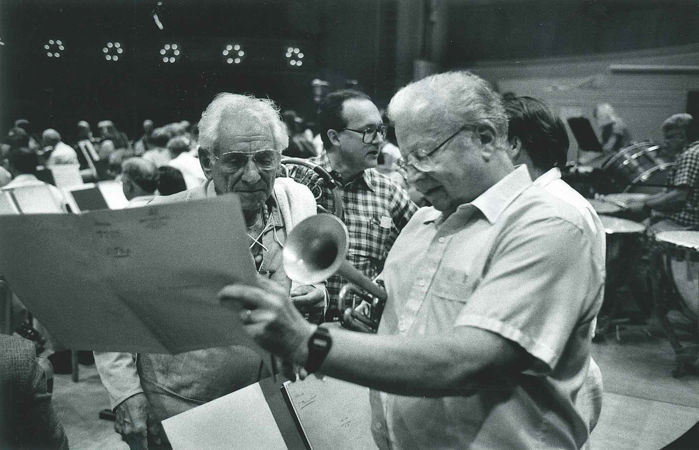
Leonard Bernstein in rehearsal with the Chicago Symphony Orchestra in June 1988
Jim Steere
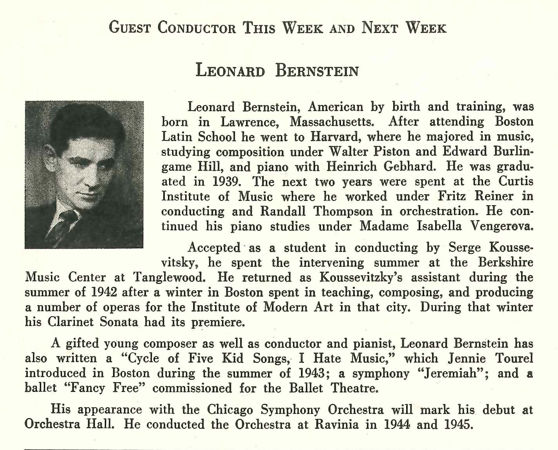
In September 1943 Artur Rodziński, music director of the New York Philharmonic, invited Leonard Bernstein to be his assistant conductor. Barely two months later, on November 14, the 25-year-old conductor was a last-minute substitute for an ailing Bruno Walter, leading the ensemble in Carnegie Hall without a rehearsal. The next day, he was the front-page story in the New York Times.
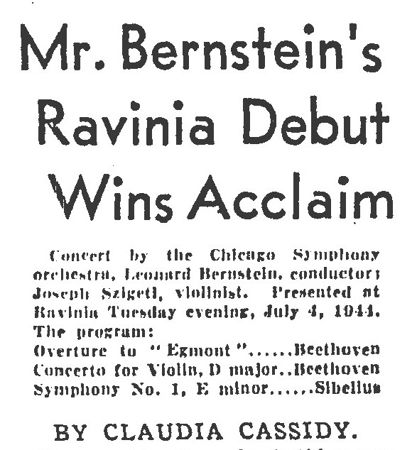
Less than a year later, Bernstein made his debut with the Chicago Symphony Orchestra at the Ravinia Festival for a four-concert residency beginning on July 4, 1944. “A fascinating fellow, this Bernstein, dynamic, emotional, yet under complete control,” wrote Claudia Cassidy in the Chicago Tribune, with “hands that gyrate so convulsively they scarcely could hold a baton if they tried, and eyes that somehow manage to be agonized, supplicant and truculent without losing their place in the score.” For the final concert of his inaugural residency, Bernstein led his Jeremiah Symphony, described by Cassidy as “undeniably impressive [and] a sound piece of work.”
Bernstein would continue to appear with the Chicago Symphony until 1956, including his debut in Orchestra Hall in 1951. After more than 30 years, he returned to Chicago in June 1988 to act as artistic advisor for the American Conductors Program, a joint project of the American Symphony Orchestra League and selected major American orchestras. For the program, he coached three young conductors — Kate Tamarkin, Leif Bjaland and John Fiore, all chosen following a nationwide competition — in works by Richard Strauss.

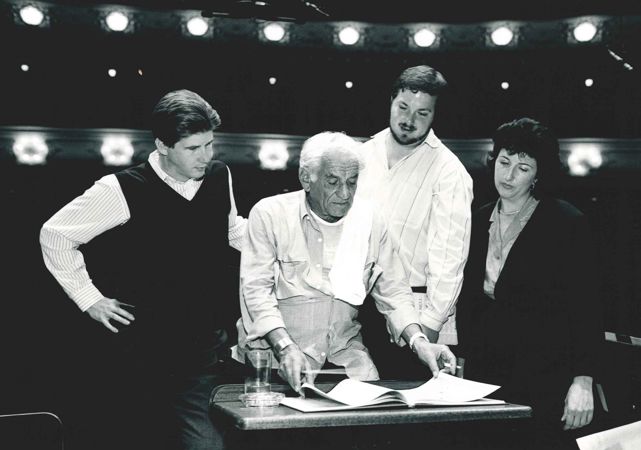
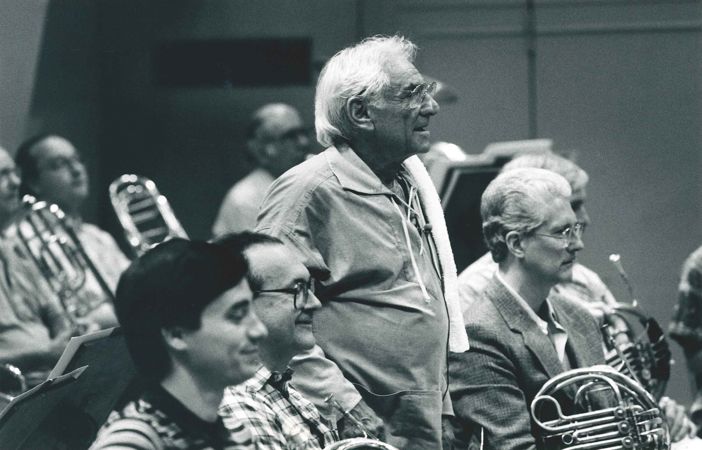
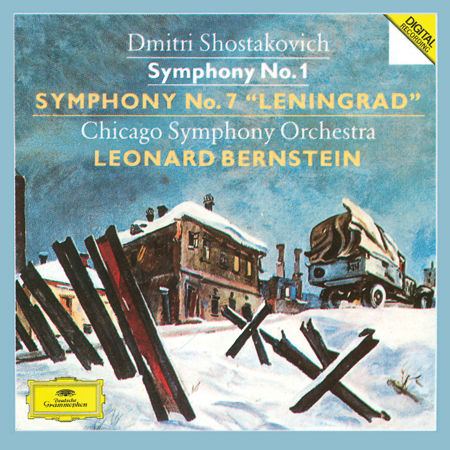
On the June 16 and 17 concerts with the Orchestra, Fiore conducted Death and Transfiguration, Tamarkin led Don Juan and Bjaland conducted Till Eulenspiegel’s Merry Pranks. After intermission, Bernstein took the podium for Shostakovich’s Symphony no. 1. The following week, he closed the Orchestra’s 97th season with Shostakovich’s Seventh Symphony (Leningrad) on June 21 and 22 in Orchestra Hall and June 24 in Lincoln Center’s Avery Fisher Hall in New York.
“I cannot recall a season finale of recent years, in fact, that sent the audience home on such a tidal wave of euphoria, and for so many of the right reasons,” wrote John von Rhein in the Chicago Tribune, following the first performance of the Leningrad Symphony. “Indeed, the conductor was constantly pushing the music beyond the rhetorical brink, then drawing back when things threatened to go over the top. Of course, he had the world’s greatest Shostakovich brass section at his ready command. The augmented brasses blared with magnificent menace, the violins sounded their unison recitatives with vehement intensity. And the woodwinds, with their always crisp and characterful playing, reminded us of the many poetic, soft sections that separate the bombastic outbursts.”
Both of Shostakovich’s symphonies were recorded live by Deutsche Grammophon and the subsequent release received the 1990 Grammy Award for Best Orchestral Performance.
Portions of this article previously appeared here. This article also appears here.


