 CSOradio
 CSOtv
CSOtv
 CSOradio
Of his composing techniques, John Adams reports that he “always tries to start with a vivid musical image and take it from there," especially for shorter works like "The Rock You Stand On."
As he approaches his 80th birthday next year, John Adams stands alongside Philip Glass and John Corigliano as one of this country’s most celebrated and accomplished living composers.
His vast repertoire includes six operas, most notably his landmark Nixon in China (1985-87), as well as works in a range of other forms. Among them are two string quartets; his quick, propulsive fanfare, Short Ride in a Fast Machine (1986), and expansive orchestral works such as Naïve and Sentimental Music (1997-98).
“I don’t feel much different than 10 years ago, although obviously as you approach 80, you tend to think carefully about what’s important with your time,” Adams said in an email interview for Experience CSO.
“I now and then say to myself, ‘I need to cut back on travel and conducting,’ but then I realize that performing is a critical part of my musical DNA. [He returned home in late April after two weeks of guest conducting the Houston Symphony and Los Angeles Philharmonic.] It calls on very different mental and social skills that, were I to just stay home full time and compose, would probably negatively impact my musical imagination. With that said, I’ve always been careful never to let my conducting career get in the way of my creative one.”
The composer remains as prolific as ever, as one of his latest creations makes clear: The Rock You Stand On (2024), a 10-minute work that was co-commissioned by nine major organizations in Europe and North America, including Carnegie Hall, ORF Radio Vienna Symphony Orchestra and the Chicago Symphony Orchestra.
The CSO’s first performances of the work will come June 4-6 on a program that is part of America 250: A Musical Journey, a monthlong series of Symphony Center events marking the semiquincentennial of the United States. The all-American line-up also will include the suite from Aaron Copland’s beloved ballet, Appalachian Spring, and another CSO co-commission, Wynton Marsalis’ Liberty (Symphony No. 5).
It’s no coincidence that the guest conductor for this set of concerts is Marin Alsop, whose ongoing posts include chief conductor of the Ravinia Festival, where she leads the CSO’s annual summer residency.
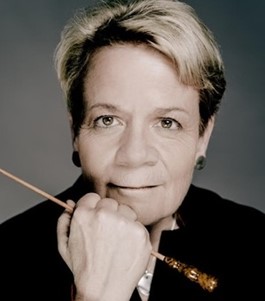 In his composer’s notes for The Rock You Stand On, Adams writes that the piece was composed as a gift to Alsop (at left), whom he describes as a close friend, a “deeply intuitive” musician and a longtime champion of his music.
“She is one of the very few conductors whom I can trust to do the right thing with what I’ve written,” he said. “She knows what I want. She ‘gets it.’ As a person, she embodies inner strength and calm and generosity, qualities that have helped her endure the long and sometimes difficult course of her career, an odyssey that has taken her to where she is now, the indisputable model for a new generation of women conductors.”
In his interview for Experience CSO, he added a kind of postscript: “I love Marin. She has an intuitive feel for my music, and she’s been doing it for at least 40 years. It was time I gave her her own piece!”
According to Adams, the work’s title is “non-specific” and is not meant to connote anything in particular other than perhaps suggesting some of the qualities that he values in Alsop — loyalty, determination and devotion.
The composer, who is also a fine writer and author of a well-received 2008 memoir, Hallelujah Junction: Composing an American Life, offers this vivid description of The Rock You Stand On:
“The piece is a 10-minute essay in powerful, pulsating rhythms that begin as individual strokes and morph into rocking syncopations passed from one section of the orchestra to another. There is a certain ‘big band’ quality to the ensemble writing, with the full orchestra at times executing irregular, bouncing figurations that are driven by an underlying jazz-inflected pulse.”
In his Experience CSO interview, Adams said he doesn’t begin with a particular plan when he writes shorter works like this one. “I always try to start with a vivid musical image and take it from there.”
The Philadelphia Orchestra and Alsop, its principal guest conductor, premiered the work in October 2025 and brought it to Carnegie Hall in early April, drawing a positive review from music critic Seth Colter Walls in the New York Times.
He found connections between this work and Adams’ most recent opera, Antony and Cleopatra, which debuted in 2022 at the San Francisco Opera, and was presented at New York’s Metropolitan Opera in May 2025.
“I had some trouble with that theatrical work,” said Walls in his review, “which I found most impressive when I focused on the churning orchestra instead of the vocal writing. Here, it was a pleasure to encounter the sleek frenzy of Adams’ latest orchestrating ideas in a purely instrumental format.”
Even more enthusiastic about the work was music critic Peter Burwasser, who reviewed the work’s world premiere for Philadelphia’s Broad Street Review. He notes Adams’ association with minimalism early in his career, but makes clear that the composer has moved on from that style.
“This new work replaces the steady pulse that characterizes that style with a lurching syncopation and bold exclamation points,” Burwasser wrote. “The vast orchestration is akin to that of a Mahler symphony, including two harps, as if to exaggerate Adams’s proclivity for lush sonority.”
He called the work a “highly entertaining outing” with a dramatic profile that feels cinematic: “On that point, there are echoes of the movie scores of Bernard Herrmann floating about in the work; notably, the music he contributed to a clutch of Hitchcock flicks (Was that a quote from ’Vertigo’?).”
As suggested earlier, few if any living American composers receive more performances of their works worldwide than Adams, as the long list of upcoming concerts and operatic productions on his website, earbox.com, makes clear.
Among the most notable recent presentations of his music took place in Florence, Italy, with the Teatro Maggio Musicale Fiorentino’s production of Adams’ The Death of Klinghoffer on April 19-26. The controversial 1990 opera offers a fictionalized look at the 1985 attack by Palestinian terrorists on the Italian cruise ship the Achille Lauro. That Adams tried to portray both the Palestinian and Israelis sides of the story with what the composer has called “equal emotional intensity” drew protests and condemnation from the Anti-Defamation League during a 2014 presentation of the opera at New York’s Metropolitan Opera.
“Because of a scheduling conflict, I was unable to attend Luca Guadagnino’s new production in Florence,” he said. ’But my wife, whose musical judgment I always value, saw it and she was very moved by Luca’s treatment of the drama — how he avoided sensationalism and saw the story as a very human tragedy of misunderstanding, distrust and ultimately terrible violence.
“I’ve seen some pretty awful productions of the opera that treated it almost like a bad television crime show. But from what I’ve heard of Luca’s version, it was very moving and drilled deep into the psychological complexities. I hope other companies will take his production, although I imagine American houses probably still consider it too controversial, which is a pity.”


