 CSOradio
 CSOtv
CSOtv
 CSOradio
Of his Magic Box tribute to the late bassist Fred Hopkins, jazz luminary Mike Reed observes: "When you make a sound, you may think nobody hears it, but there may be a message in a bottle coming through long after you’re gone."
Mike Reed is never at a loss for resources. The drummer’s compositions draw from deep dives into music history and ongoing exchanges with local and global colleagues. But the impulse for his Chicago Inspirations event May 1 at Symphony Center came from an unexpected find. He was given a container of papers belonging to the bassist Fred Hopkins, who died in 1999 at the age of 51. Reed knew about Hopkins’ role in jazz, and he also thought about what that collection meant for himself.
“We all have this box, especially musicians,” Reed said. “Like, ’Oh, that program from the first festival I ever played in Germany,’ Notes. Set lists. Love letters. Looking at something and you see some of these things, and there’s a response that lives in somebody else’s attic, or basement or landfill. It’s nothing crazy like some weird harmonic second invention. It’s just life.”
Hopkins’ effects included documents that reflected his exceptionally creative life, as he performed and recorded with numerous prominent jazz musicians in Chicago’s adventurous Association for the Advancement of Creative Musicians and New York City’s artist-driven loft scene during the 1970s. Their writings were included among his papers, which were almost lost forever.
“People were throwing it out, and it was like, ‘Woah, do you know what this is?’ ” Reed said. “There were original [pianist] Muhal Richard Abrams’ scores, [saxophonist] David Murray’s compositions, contracts with Warner Brothers, stuff that means a lot to a lot of people, including myself. There’s this phone-book-sized handwritten AACM meeting minutes from 1981 to 1986. Wild stuff like that. So let’s make something new out of something old.”
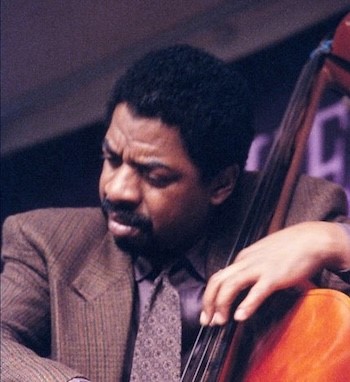 Reed recognized how these musicians amplified and personalized vital legacies. In the 1970s and ’80s, Hopkins (at left) co-led Air, a trio with drummer Steve McCall and multi-reedist Henry Threadgill. The group’s open perspective included reworking early 20th century jazz and ragtime as they envisioned them. Two of Reed’s ensembles — Loose Assembly and Artifacts — have interpreted Air’s works, and he feels an affinity for McCall as a drummer, who was also an imaginative composer.
Recently, Reed met with Threadgill, who is contributing a piece to Chicago Inspirations. While Threadgill continues to receive acclaim for his musical innovations and a remarkable 2023 memoir (Easily Slip Into Another World), Reed highlights a quality that remains overlooked. “As much as he’s praised with really highbrow, complex jazz, it’s really the songs, vibes and the grooves that are the best part of what’s going on,” Reed said. “It’s serious, but it’s also a good time.”
Reed’s own work reflects a similar approach that is intricate, but also upbeat. Throughout his albums with People, Places & Things, constantly surprising melodic twists and shifting rhythms never abandon the underlying ebullience of the tunes themselves. He also conveys myriad thematic tones through diverse projects. His previous performance at Symphony Center, Flesh & Bone in 2018, was a musical answer to a racist attack that his group encountered in Europe. But he says that Chicago Inspirations will be personal rather than political.
Other Chicago musicians share Reed’s sense of cultural advocacy. Saxophonist Geof Bradfield’s opening set for this program will feature another interpretation of musical history; it connects to another of Reed’s projects. Leading a septet of talented high school students (recruited from the Jazz Institute of Chicago’s Jazz Links Student Council Program), Bradfield and company will interpret Chicago musicians’ compositions that Reed compiled for the 2019 book, The City Was Yellow: Chicago Jazz and Improvised Music 1988-2010 and includes Bradfield’s “Nairobi Transit.”
That book’s notations of earlier and contemporary Chicago jazz composers highlight community and continuation. For Reed, these values also mean creating performance spaces for shared conversations among different generations of musicians. Those include his own venues Constellation and Hungry Brain, as well as the Sound & Gravity Festival, which will be held in September for its second year. Seeing how artists interact in real time — and how audiences respond to them — in these rooms offer an immediate sense of how these efforts make a big impact, particularly in this city. But, as Reed noted, sometimes musicians’ lasting influence may be unknown until perhaps a chance discovery years later.
“People’s lives touch each other in ways that come around and come around,” Reed said. We can go on and on about Von Freeman, Fred Anderson, Jodie Christian, The New Apartment Lounge, and these people and things still echo, ripple across a pond and keeps on going now through other voices. Maybe that’s the important thing: To try to tell people that when you make a sound, you may think nobody hears it, but there may be a message in a bottle coming through long after you’re gone. That there’s something I make for somebody, and it might mean so much to somebody I’m never going to meet. It might be just waiting there.”


