 CSOradio
 CSOtv
CSOtv
 CSOradio
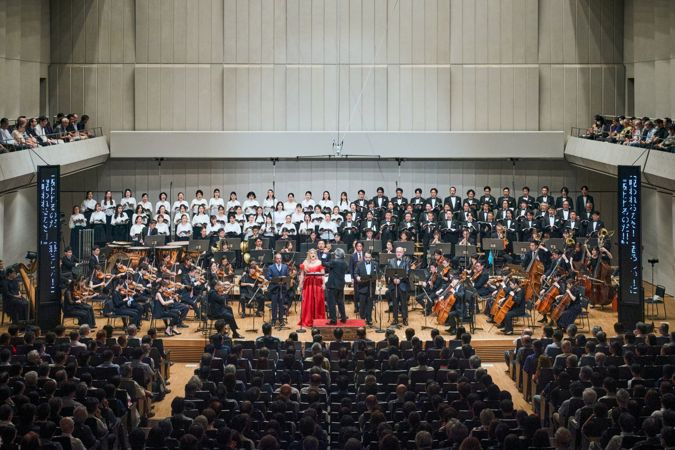
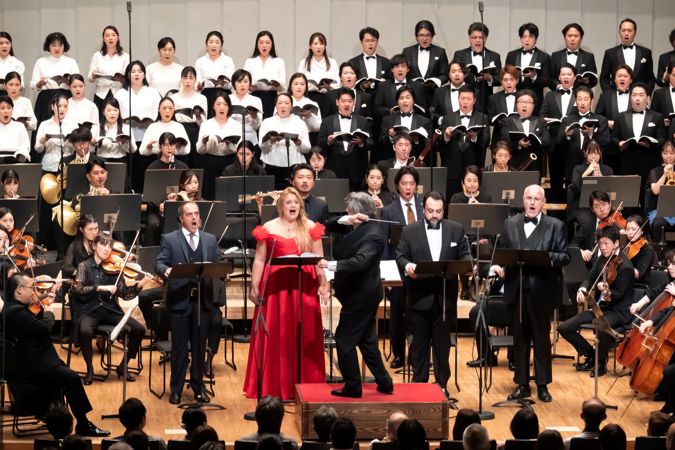
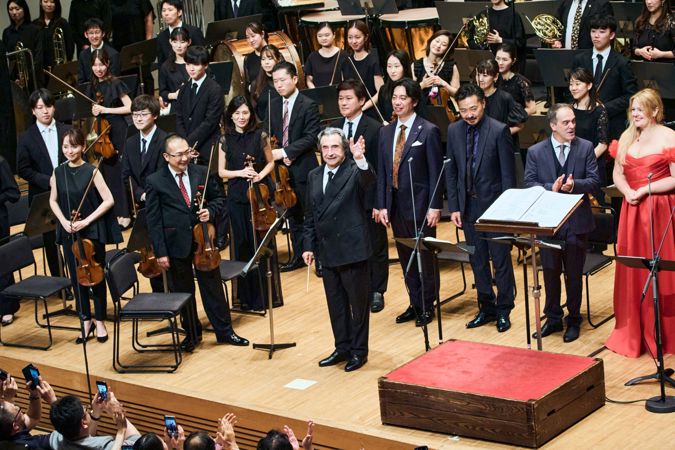
Riccardo Muti conducted two concert performances of Verdi's "Simon Boccanegra" at the conclusion of the fifth edition of the Italian Opera Academy in Tokyo on Sep 13 and 15, 2025.
© Tairadate Taira
The CSO’s Music Director Emeritus for Life Riccardo Muti had an eventful summer and early fall that included his annual concerts at the Salzburg Festival, the latest edition of his Italian Opera Academy in Tokyo and new honors bestowed upon him in his native Italy. He returns to Chicago for two weeks of concerts, Oct 30-Nov 1 and Nov 6-8.
For some thirty years, Muti has conducted special concerts with the Vienna Philharmonic during the Feast of the Assumption of Mary at the Salzburg Festival. Muti inherited this annual August 15 concert date from Herbert von Karajan. However, Muti’s programs have become so popular that there are now three performances. On this occasion, Muti conducted Schubert’s Tragic Symphony No. 4 and Bruckner’s Mass No. 3 in F Minor, considered the Austrian composer’s most important and final mass setting.
Muti’s Salzburg concerts were, as Wilhelm Sinkovicz of Die Presse pointed out, “notoriously sold out.” He continued in his review, “Anyone who experiences Muti conducting Schubert also understands why this is so. The Fourth Symphony, in particular, a work by a teenager, was not taken entirely seriously even by seasoned Schubertians. Muti, who recorded the entire Schubert cycle with the [Vienna] Philharmonic, always thought differently.”
The second half of the program featured Bruckner’s Mass in F Minor, a deeply spiritual and life-affirming work written while Bruckner was still working as an organist in Linz, shortly before his move to Vienna. Requiring the considerable forces of four soloists (including soprano Ying Fang, alto Wiebke Lehmkuhl, tenor Pavol Breslik and bass William Thomas), a large choir (Vienna State Opera Choir) and a huge orchestra (the aforementioned Vienna Philharmonic), the work marks an important crossroads in Bruckner’s career and is emblematic of the enigmatic and powerful symphonies to come after his relocation to Vienna in 1868. “After interpretations of the Seventh and Eighth, it seems fitting that Muti should also celebrate Bruckner’s greatest mass composition in Salzburg, with the serenity that this music demands,” wrote Florian Oberhummer in the Salzburger Nachrichten.
Muti conducted Bruckner's Mass No. 3 in F Minor at the 2025 Salzburg Festival, following performances of Bruckner's symphonies nos. 7 and 8 in previous seasons.
© Salzburg Festival/ Marco Borrelli
“In this setting of the Mass, the Vienna Philharmonic’s strong contrasts in dynamics and timbres were wonderfully realized with excellent solo performances under the once again commanding Riccardo Muti.” — Helmut Christian Mayer, Kurrier
Reviews described the anticipatory "gala-like" atmosphere at Muti's annual concerts with the Vienna Philharmonic at the Salzburg Festival.
© Salzburg Festival/Marco Borrelli
“The conductor focuses on the majesty and beauty of great sound. This was emanated by the Vienna Philharmonic, who, under Muti’s direction, traditionally display their finest tonal qualities.” — Florian Oberhummer, Salzburger Nachtrichten
Muti conducting the Vienna Philharmonic, Concert Association of the Vienna State Opera Chorus, and soloists Ying Fang (soprano), Wiebke Lehmkuhl (alto), Pavol Breslik (tenor) and William Thomas (bass).
© Salzburg Festival/ Marco Borrelli
“Maestro Muti first conducted the Vienna Philharmonic in 1971. In recent seasons, he has gone from strength to strength. I think of an Aida (the Verdi opera). Those Bruckner symphonies, that Beethoven mass. Two Tchaikovsky symphonies: 4 and 6. This Bruckner mass. The guy is on a roll.” — Jay Nordlinger, The New Criterion
From Sep 2 to 15, Muti led the fifth iteration of the Italian Opera Academy in Tokyo, focusing on Verdi’s Simon Boccanegra. During the two-week Academy, Muti trained five young conductors selected by audition: Jacob Niemann, Kentaro Machida, Wei Lin, Eigo Sato and Hyungsup Lim. The daily rehearsals were open to the public. The young conductors led performances on Sep 11, while Muti led a master class for the conductors with full orchestra, chorus and soloists on Sep 2.

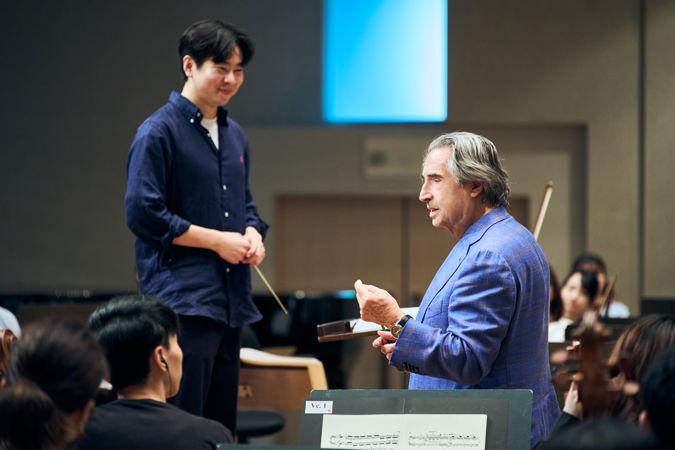
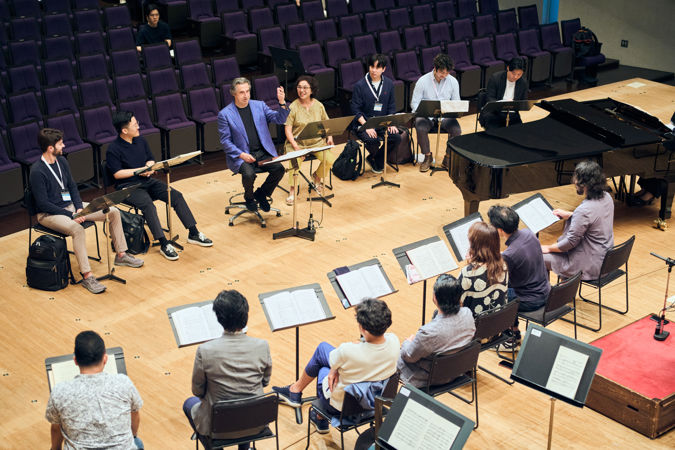
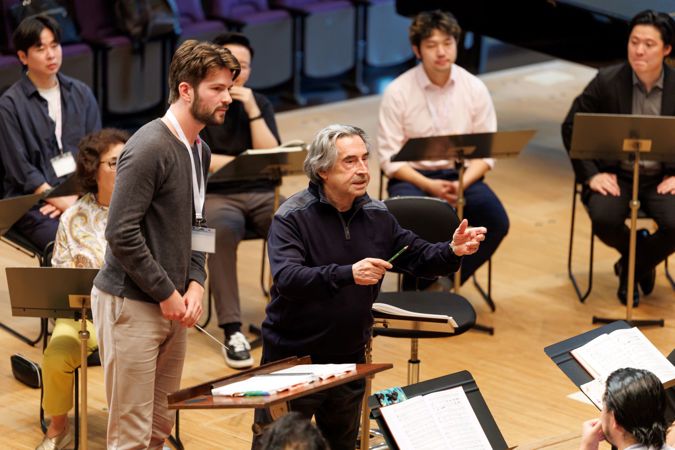
Muti also conducted two concert performances of Verdi’s Simon Boccanegra as the grand finale of the Italian Opera Academy in Tokyo, Vol. 5. The production featured a remarkable cast, including baritone George Petean (Simon Boccanegra), soprano Iwona Sobotka (Amelia), bass Michele Pertusi (Jacopo Fiesco) and tenor Piero Pretti (Gabriele Adorno) performing with the Tokyo-HARUSAI Festival Orchestra and Tokyo Opera Singers, under chorus master Junya Nakata.
On Sep 25, in Santena, near Turin, the Cavour Foundation President Marco Boglione awarded the Premio Cavour 2025 (Cavour Prize) to Riccardo Muti for, “masterfully embodying Italian musical and artistic tradition, starting with the work of great composers such as Giuseppe Verdi; he deserves credit for promoting Italy and its values through music as a universal language among peoples.” The Cavour Foundation was established in 1955 to promote Cavourian studies and deepen knowledge of the work and teachings of Camillo Benso, Count of Cavour (1810-1861), a leading figure in the movement towards Italian unification. The Cavour Prize was established in 2007 and is awarded to those, “who have contributed and continue to contribute to the work that Camillio Benso di Cavour dedicated his enitre life: the unity of Italy, the strengthening of the structure of the national state, the political and economic belonging of [Italy] to the European community.”
In an interview with Antonella Torra for La Stampa, Muti said, “Italy has an extraordinary, unique history. Its roots are rooted in a cultural, human and artistic heritage that continues to define who we are. . . . When I’m in Chicago, in the cold, I leave the theater and see Michelangelo, Raphael and other great Italians sculpted on the facade of the Art Institute. Seeing those names warms me. My fortune was born here, and the beauty we created is the foundation on which we can still stand today.”
Riccardo Muti also led several performances with the Cherubini Orchestra, the youth orchestra he founded in 2004, throughout Italy, including concerts in Agrigento (Sicily), Codroipo, Lucca and Pompei this summer. In September, he conducted the Cherubini Orchestra on a three-concert tour of Como, Reggio Emilia and Venezia, performing Beethoven’s Coriolan Overture and Symphony No. 7 as well as Mozart’s Flute Concerto No. 2 in D Major (K. 314) with Karl Heinz Schütz, Principal Flute of the Vienna Philharmonic.
Following the October 7 concert at Teatro Valli in Reggio Emilia, Mayor Marco Massari presented Muti with the Primo Tricolore, the city’s highest honor, “for his artistic merits, the social values he has conveyed, and the closeness he has demonstrated to [local] citizens.”
The Italian national flag is officially called “il Tricolore,” or “the three colors.” The flag featuring three equally sized vertical stripes of green, white, and red was first adopted in Reggio Emilia by the Cisalpine Republic on January 7, 1797, marking the first time the Tricolore became the national flag of a sovereign Italian State. The city’s Palazzo Coumnale houses the Tricolore Hall and the Museum of the Italian Flag.
During the presentation, which followed an encore performance of music from Verdi’s Nabucco, Mayor Massari also reflected on how through Muti’s work with the Cherubini Orchestra he has given, “a voice and a future to generations of young musicians,“ representing, ”the values of the Primo Tricolore: excellence, openness to the world, and the ability to translate personal talent into common good.”

